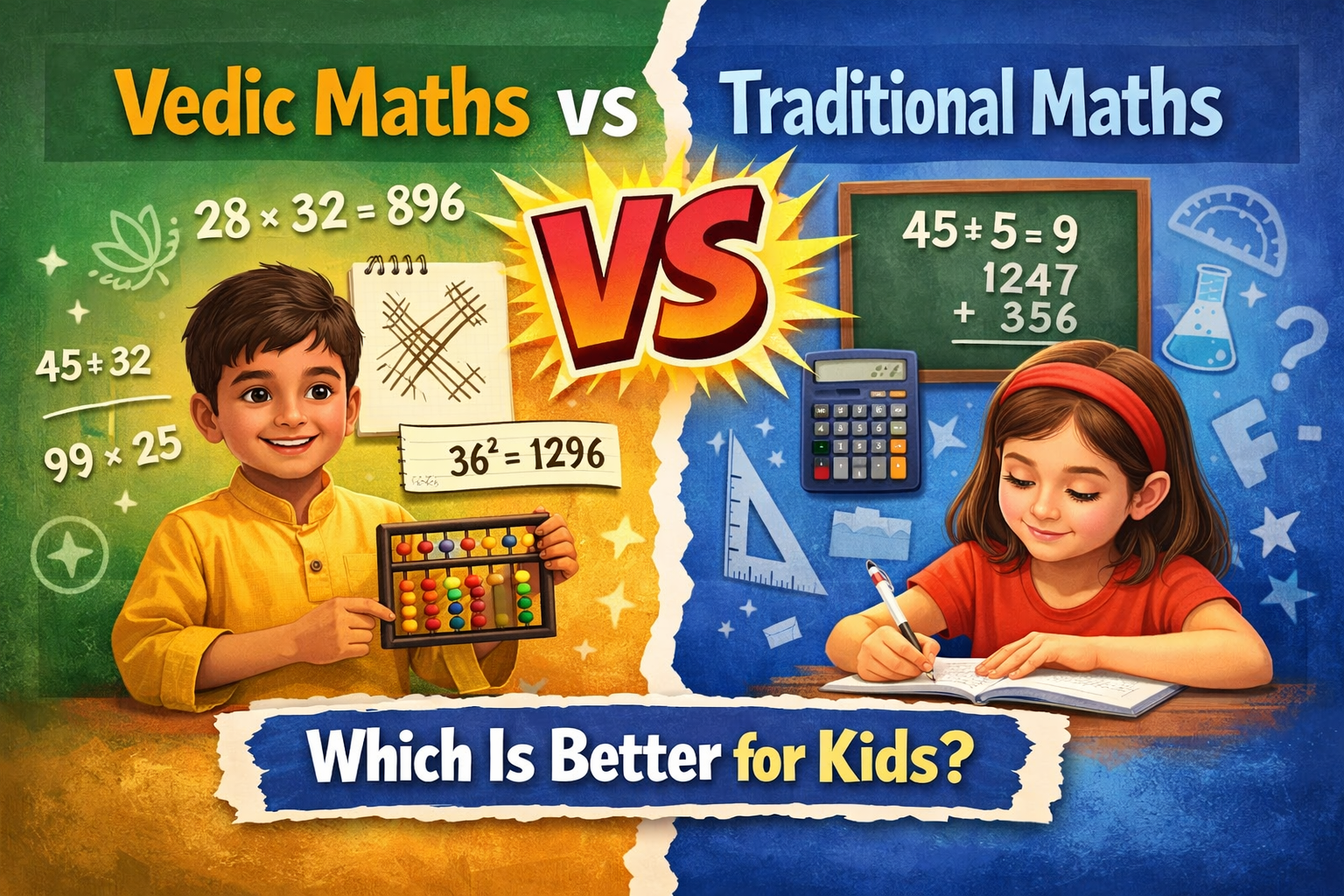
When comparing Vedic Maths for kids and Traditional Maths, it’s important to consider the learning objectives and the child’s individual needs and then understand the differences that will help us make the right decision for our children.
Vedic Maths emphasizes speed, mental calculation, and flexible problem-solving, which can boost a child’s confidence and interest in mathematics. However, traditional Maths offers a systematic approach, building foundational concepts through step-by-step methods that align closely with school curriculum.
Key Benefits of Vedic Maths for kids over Traditional Maths
Key benefits of Vedic Maths over Traditional Maths include fostering mental agility and encouraging creative approaches to problem-solving, which can be especially valuable for children who thrive on quick thinking and adaptability. Vedic Maths techniques often enable students to tackle challenging calculations with ease, promoting a sense of accomplishment and motivating them to explore mathematical concepts beyond the classroom. This not only enhances their performance but also nurtures a positive attitude towards mathematics, complementing the structured methods of traditional Maths.
On the other hand, if a student is only learning maths via traditional methods in school, it often becomes monotonous which is the biggest factor why kids lose interest in Maths at an early age itself. If parents and teachers introduce fun in the teaching style, then many students would love to study Maths and continue with Maths even at higher levels. Its just about adapting the teaching style a little, and Vedic Maths tremendously helps to achieve this objective in an effective way.
Let us look at a simple examples to understand the power and benefit of Vedic Maths
Squaring numbers ending in 5
To square a number that ends in 5, take the digit before 5 and multiply it by its successor. Then, append 25 to the result.
For example: the square of 35 =
- Step1: (3 x (3+1)) =12
- Step2: Append25 to the result which is = 12 25
- Answer is 1225
Can I Learn Vedic Math at Home?
Certainly. The emergence of online learning platforms and the extensive resources now available have made studying Vedic Maths from home more accessible than ever. Below are several recommendations to guide you as you begin this journey:
- Start with the Basics – Begin by learning the Vedic Maths sutras, their meanings, and uses as your foundation.
- Practice Regularly – Master Vedic Maths with daily practice. Set aside time each day (minimum of 15 minutes) to practice, and repeat the similar questions until you become confident.
- Use Online Learning Resources for Vedic Maths – Internet is full of learning material for Vedic maths tricks. There are videos, articles as well as presentations to help you learn. I personally found www.vedicmath.org the best source of learning Vedic math tricks, although you need to work quite hard to keep up the pace with their learning programs.
Who should learn Vedic Math at Home?
Anyone (a student or a homemaker, or a business man) who is looking to get initial insight into what is vedic maths and what kind of tricks it provides, can learn Vedic Maths at home for the first few weeks. But remember that if you are serious about learning Vedic Maths in a professional way, then we strongly advise you to reach out to a good professional tutor so that your time and energy is not wasted. Learning at home can be a good way to solve your curiosity or just for fun, but only a professional tutor can create a strong foundation for structured learning.
What is the best age to enroll into Vedic maths classes?
Typically Vedic Maths classes are recommended for students in the age group of 11+ years. Reason being that it is advisable to have a good handle on basic arithmetic so that the student can do simple addition and subtraction mentally while applying Vedic Maths tricks.
Summary
Ultimately, choosing between Vedic Maths classes and traditional Maths depends on a child’s learning style and academic goals. Integrating both methods can provide a balanced mathematical foundation, allowing children to develop strong fundamentals while also enhancing their ability to solve problems quickly and creatively. I enrolled my son with Mathcruise school a few months ago and I am glad to see that every vedic math class is proving to be really productive and he is loving Maths more and more with every passing day, which fully meets the objective I had in mind at the time of enrollment.